
Black Sheep of the Codling Family

Father, farmer, fraudster and fake. All of these words describe my not-so-great-grandfather Stephen Codling, the Black Sheep of the Codling Family.
Stephen was born in Blenheim Township, Oxford County, Ontario, Canada, on August 1, 1851, to Elijah (1817-1889) and Mary Ann (Chesney) Codling (1822-1907). Both Elijah and Mary Ann were born in Norfolk, England. Married in Canada, they arrived separately sometime after 1841 but before 1851, according to British census records.
The fourth of six siblings, Stephen served in the Canada Volunteer Militia at least two years––1868 and 1873, when he was 17 and 22, respectively. The records show he was a private in the 6th Company of the 38th Regiment, also known as the Brant Battalion, and that he was paid 50 cents per day during two annual June trainings at Camp Niagara, earning a total of $16 for both years.
Stephen married Phebe Ann Hersee on April 30, 1873, in Blenheim, where she was born November 8, 1854, \to Henry and Rachel (Marlatte/Marlette) Hersee. Henry came to Ontario from Sussex, England. Rachel’s family story has been much more elusive; I have found few records for her and her family. Even the correct spelling of her surname is unclear.
After their marriage, possibly using some of the money he earned in the militia, Stephen purchased one-fifth of an acre in Blenheim Township in 1875 from John Dawson for $35 Canadian. The deed states Dawson was a merchant and Stephen was a tailor, which also is the occupation listed for Stephen on his marriage record. Every document after thes, however, lists his occupation as a farmer or gardener.
A year later, in 1876, Stephen received a land grant for 160 acres of unimproved land near the town of Dennis in Prince Township, Algoma, Ontario, Canada, just north of Sault Sainte Marie and Michigan’s Upper Peninsula. By then, the couple had two children, George Henry, born 1874, and Charles, my paternal grandfather, born December 25, 1875.
The Canadian land grant required the homesteader to clear and cultivate at least 15 acres of the land received within the first five years of taking residence. Sometime around the enumeration of the 1881 Canada census, around the deadline of the requirement of the land grant, the family moved to Barnes County in the Dakota Territory, now North Dakota. The family is included that same year in the Canada census for the town of Dennis, Prince Township, Algoma, Ontario, Canada:
Stephen, 30, head of household
Phebe, 27, wife
George H., son, 7
Charles C., son, 5
Stephen S., son, 3 [middle initial should be A]
Eliza E., daughter, 1
Rosetta G., daughter, one month
A note made on the last page of the Dennis census shows that it was completed at the end of May that year. But when they moved is unclear, mainly because on June 1, 1881, days after the Canada census, Stephen made his first application in Barnes County, North Dakota, for U.S. citizenship. Phebe’s naturalization documents and subsequent U.S. census records indicate the family arrived in North Dakota in May of 1881, entering the U.S. through the Lake Superior port of Duluth, Minnesota.
Territorial law required a person to live there for two years before filing the so-called “first papers” for naturalization, which further muddies the timeline. Perhaps Stephen left Dennis ahead of the family to get settled in Dakota and then returned for them at the same time the census-taker stopped at their residence. Or, perhaps another informant gave the census-taker information that they lived there, even after the Codlings had already left.
The latter hypothesis may sound unusual, but Stephen Codling did not seem to be fond of doing things the “usual” way. Either way, no documents have been found to show Stephen had lived or was living in the Dakota Territory before 1881.
Sorting Out the North Dakota Years
In 1884, Stephen received a land patent for 161.53 acres in Barnes County, where the family appears a year later in the 1885 Dakota Territorial census, listed with the other residents of the pioneer town of Gra-Green in that county:
Stephen, 34, head of household
Phebe, 38, wife
George, son, 12
Cicero, son, 10
Edward, son, 7
Teddy, son, 5
Gertrude, daughter, 3
Lotta, daughter, 8 months
There is a new baby in the family, Lotta, whose name is Bertha F. (the initial stands for Flora). The discrepancies between this census and the 1881 census beg the question: Who gave the information to the Barnes County census-taker?
First, Phebe would have been 31 and not 38; children Stephen S. (whose name is Stephen Arthur) and Eliza are not listed; and the identities of the two children named Edward and Teddy are not immediately clear.
Phebe’s age can easily be chalked up as an error by the census-taker. But teasing out the discrepancies with the children took a lot more time.
Revisiting the birth records from Algoma, the son “Edward” in this census is likely Stephen Arthur. The age given in the 1885 census for Edward lines up with the date given on Stephen Arthur’s birth record.
Determining Teddy’s identity was more complicated, because mistakes made (which are repeated in online family trees by other researchers) worked to create much confusion:
First, the person indexing the digitized copy of the Algoma birth records for September 1879 appears to have misinterpreted the “j” in “Elijah” as a “z”; however, the record itself and the information in the index both give the child’s middle name was Edward and indicate the child was male.
Second, Elijah Edward appears to have been misidentified in the 1881 census, again, as “Eliza E.,” and is listed as a one-year-old female.
Negative evidence leads to the conclusion that Elijah and Eliza are the same child. While there is a birth record for Elijah, there is no birth record to be found for an Eliza Codling around 1880 in Algoma, Ontario, Canada.
Circumstantial evidence leads to the same conclusion: first, the age for the child listed on the 1885 census as Teddy lines up with Elijah Edward’s date of birth; second is the family’s continued use of the name Edward and the nickname Teddy. My Dad’s oldest brother Edward, born in 1910, whom my Aunt Iris had lovingly referred to as Teddy, apparently was named in honor of Charles’ younger brother.
Other things have added to the confusion. For example, during his short life, Elijah preferred to be called by his middle name, Edward, until his death from cancer in 1906 at the age of 26. Both his death certificate and probate records refer to him as Elijah Edward Codling and, subsequently, as Elijah.
A second complication in trying to suss out all of the children born to Stephen and Phebe comes from information given about Phebe in the 1900 U.S. census and on her death certificate four years later. Both indicate that she had given birth to a total of nine children, but that only seven survived. So far, vital records have confirmed the birth of only seven children to Phebe.
The most reasonable explanation would be that Phebe may have suffered the still-births of one or two children, or that one or two children were born alive but died within days, weeks, or even months afterward, and none of those life events was ever reported. This seems plausible when considering the information on Elijah Edward’s birth record, which states he was born September 23, but that his birth wasn’t reported until almost a week later, on September 29; also, Stephen Arthur’s birth record shows he was born January 9, 1878, but that wasn’t reported until April 8—three months later.
Baa, Baa Black Sheep
Life for the Codling family from 1885 to 1900 appears to have been quite complicated. On the surface, all seems normal: Stephen had obtained two more land patents, one on July 18, 1895, for 144 acres, and another on September 20, 1896, for an additional 160 acres. Interestingly, though, neither of the additional properties were adjoining to the original acreage of the 1884 land patent; both appear to be a few miles east of the first.
Stephen did follow through with obtaining his citizenship; his naturalization papers are dated December 22, 1891. Witnesses named in that document were Jacob Werth and Charles S. Walker; both affirmed that Stephen and his family had been living in the North Dakota territory for five years (as required), and that “he has behaved himself as a man of good moral character … and well disposed to the good order and happiness of the [United States].”* Stephen swore to and signed an oath renouncing his allegiance to Queen Victoria of Great Britain and Ireland, and was granted citizenship by Judge Roderick Rose.
In May that year, Phebe applied for her first papers, but never went on to obtain citizenship. Additionally, none of the children appear to have been naturalized. The laws at that time allowed for children under 21 living with their father when he was naturalized would then obtain “derivative” citizenship through him. However, it’s not clear if Stephen was actually living in the same household as the rest of the family in 1891; in fact, based on the location of the latter two land patents (1895 and 1896), he may not have been.
What was going on? That’s very hard to say. According to an article about Stephen, which was published on Page 14 in the December 6, 1888, issue of the Jamestown Weekly Alert (Jamestown, North Dakota):
Sanborn Enterprise: Steve Codling one of the pioneer farmers in this section of Barnes county, disappeared last Sunday night [December 2], leaving a sick wife, several children, and numerous debts behind. Two of his children went with him, six remaining with the mother. Too many first mortgages is said to have been the cause of his sudden exit.
What prompted his “sudden exit,” apparently, was a lawsuit filed against him by the St. Paul (Minnesota) Fire and Marine Insurance Company in June of the same year. Apparently, he had secured an insurance policy from this company in 1884 for $24, which was to be paid in annual installments of $6 from 1885 to 1888. A note on one page of the court documents shows that the papers were “served by leaving with wife Phebe Codling at his residence.”
Further, the documents state:
C.E. Joslin, being duly sworn, says he is the Attorney for the Plaintiff in the above entilted action, and that no Answer or Demurrer or copy of either therein has been received by Plaintiff’s Attorney, or appearance in any manner made by the Defendant, and that more than thirty days have elapsed since the service of the Summons and Complaint upon Stephen Codling.
Joslin petitioned the court for the amount owed––$24, plus interest and court fees, for a total judgment of $39.55. So far, no other documents have been found regarding Case No. 98-4817, filed in the Third District Court in Cass County, North Dakota. It’s quite likely Stephen made himself scarce and never paid his debt.
This is one of many situations for which the loss of the 1890 U.S. census, which was destroyed in a fire, becomes acutely frustrating. What Stephen and the rest of the family were doing and where they were living between 1896 and 1900 is largely unknown. The only known information during that time frame is that their son Charles enlisted in the U.S. Army and served throughout the two years of the Spanish-American War. At the end of the war, the 1900 U.S. census shows that he joined his mother and siblings in Arthur, Clare County, Michigan, where Phebe had other family:
Phebe, 43, widowed
George, 26
Charles C., 24
Arthur S., 24
Edward E., 19
Rosa [Rosetta] G., 18
Bertha F. [Lotta], 15
Ethel E., 13
Note that Phebe’s marital status is listed as “widowed.” But had Stephen died? Online family trees that I found at the very beginning of my family history research 34 years ago indicated that Stephen died in 1916 in Carin, Michigan. The problem with those trees, as so often happens, was this fact had no documentation, no evidence, to substantiate it. This was compounded by the fact that there is no place named Carin, incorporated or otherwise, that has ever existed in the Wolverine State.
But, let’s stick a pin in the mystery of Stephen’s eventual demise and circle back a bit.
It turns out the same 1900 census lists a man named Stephen Cutting living in Osceola Township, Osceola County, Michigan, southeast of Clare County. This man was described a naturalized citizen, age 47, born about 1852 in Canada, with parents who were born in England; he is a farmer, and owned his home and farmland.
Clearly, this is my great-grandfather; my original assumption was that "Cutting" was a misspelling of "Codling." And other information seemed to have been recorded in error. Below his name is listed a female named Gertrude, age 18 and born March 1881 in Canada. Clearly, this was his daughter, Rosetta Gertrude, but in this census she is listed as Stephen’s wife.
It had to be an error; there are no records of Stephen marrying anyone—in North Dakota or elsewhere—in 1899, or any other year.
Additionally, the census lists Beatrice L., age eight months, born December 1899 in North Dakota, and catagorized as the couple's daughter. This information suggests that Stephen and Gertrude were living as man and wife, and that they, as a couple, had had a daughter.
Surely this had to be an error. But it wasn't. The answer was found in a teeny-tiny newspaper article buried at the bottom of the third column of Page 8 in the April 25, 1908, issue of the Saginaw (Michigan) Evening News:
Farmer Arrested on Serious Charge
Evart, Mich., April 25––Stephen Codling, alias Cutting, a farmer living a mile and a half east of Evart, was arrested Friday on a serious charge. The complaint was made by his sister, Sarah Chesney. Codling was arraigned but waived examination and was remanded to the Hersey jail to await trial at the June term of the circuit court.
It turns out that the “serious charge” was incest. The census-taker had made no mistakes: Stephen was using the name “Cutting” as an alias, probably for this reason and the fact that he was on the lam from his other misdeeds in North Dakota. He intentionally identified his own daughter as his wife, and accurately identified the infant as their daughter.
By 1908, Stephen had fathered two more children with Gertrude: Lawrence Edward, born in 1902, and Cecil Edgar, born 1906. Lawrence died from pneumonia in 1905; his older sister, Beatrice, and younger brother, Cecil, lived until 1986 and 1971, respectively. At some point, Stephen’s sister, Sarah (Codling Ross) Chesney, apparently discovered Stephen was having a sexual relationship with her niece. How she made this discovery in 1908 is unknown, but clearly she was having nothing to do with it and was strong enough to report her own brother’s misdeeds to the authorities.*
From the court record:
Complaint for Incest
Filed this 24th day of April 1908
Irvin Chase, Justice of the Peace
Judson E. Richardson, Prosecuting for said County (Osceola), for and in behalf of the People of the State of Michigan, comes into said Court, in the June 1908 term thereof, and gives it here to understand and be informed, that Stephen Codling, late of the Township of Osceola in the County of Osceola and State of Michigan, heretofore, to wit: on the 18th day of April in the year one thousand nine hundred and eight, at the Township of Osceola in said Osceola County. did commit fornication with one Rosetta Gertrude Codling, by having carnal knowledge of the body of her, the said Rosetta Gertrude Codling, she the said Rosetta Gertrude Codling being then and there the daughter of him, the said Stephen Codling.
_____________________________________________________
People vs. Coddling [sic]
Defendants’ Request to Charge
First: Incest is the concurrent act of sexual intercourse between persons of opposite sexes related by blood within the degrees of consanguinity within which marriage is prohibited by law, they at the time having knowledge of the relations, and you must find from the evidence that Gertrude Coddling [sic] is the daughter of the defendant begotten by him and that he had sexual intercourse with her on or before the 18th day of April 1908, as charged in the information with her consent and with knowledge of the relation or you cannot convict …
Second: I charge you that you must find from the evidence that the defendant committed the specific act of sexual intercourse charged in the information on or before the 18th day of April 1908, and that you cannot convict the defendant on any other act except the specified act charged.
Young & Reasley
Attorneys for the Defendant
In the end, at age 55, Stephen Codling—described in a prison document as five-feet, five-inches tall, of medium build with dark chestnut-colored hair (speckled with gray), and azure blue eyes—was convicted on June 8, 1908, on just the one count of incest, despite having fathered three children with his own daughter. He entered Jackson State Prison three days later, June 11; he served 10 years of his 7-and-a-half to 15-year sentence, being paroled on June 13, 1918.
Bye, Bye Black Sheep
Stephen’s eventual demise was solved when I decided a few years ago—just one more time—to type his name into the search field at Ancestry.com; this time, I didn’t restrict the search in any way. And, boom! There in the results was what family researchers had been looking for all this time: a state death index showing that Stephen died on August 30, 1925, at the age of 73. He was buried in Woodland Cemetery in Jackson.
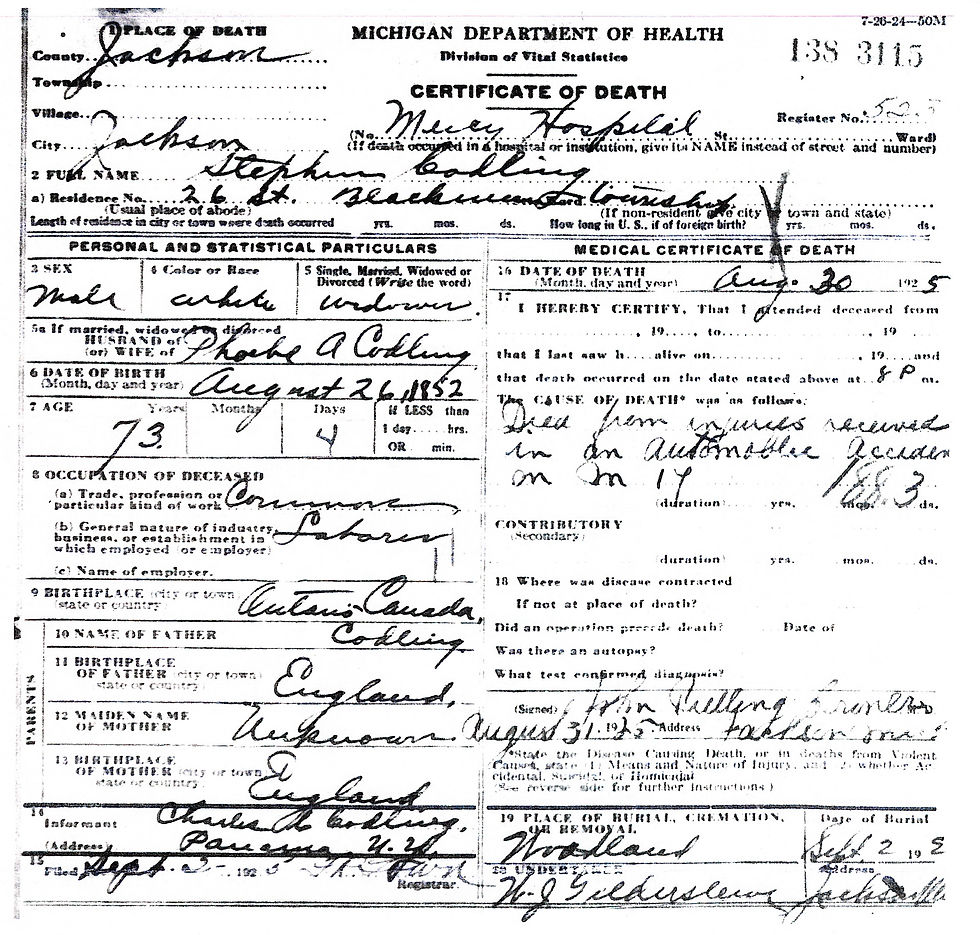
How the family came to the conclusion he died in 1916 is unclear, but it turns out that Carin, Michigan, was a misinterpretation of a note Beatrice had jotted down in a journal that said Stephen had died that year in a “Car in Michigan.”
A Car. In Michigan. She inadvertently created quite the wild-goose chase for many Codling family historians. But more answers came in an article about his death, published September 2, 1925, on Page 14 of the Jackson Citizen Patriot:
ESTATE OF RECLUSE VALUED AT $3,500
Stephen Codling, aged recluse, fatally injured when struck by a large automobile while riding toward his home on a bicycle, left an estate valued at several thousand dollars, it has been disclosed.
Stock, said to have been found in the man’s home following his death, is said to total $3,500 and there is believed to have been other property. The man was living alone and appeared to be in frugal circumstances until it was learned of his holdings in several companies. His home was a mere shack just off M-17 west of Jackson.
The National Union Bank has been named special administrator of the estate by Probate Court.
The inquest into the circumstances of the man’s death will be held Thursday at 3 o’clock in the county building.
Having died intestate (without a will), his probate folder contained dozens of documents that included more than 100 pages. An inventory showed he died with the following assets: $122.30 in cash; 25 shares of stock in Consumers Power Company, valued at $2,500: and three parcels of land in Jackson city and county: Lots 18 and 19 of Fernwood Gardens ($300) and Lot 33, Block 2, of the Elmwood Park Subdivision ($200). The grand total: $3,122.30.
According to the WestEgg.com Inflation Calculator, the amount of his holdings, in today’s money, would be about $58,600.
Charles Codling, my grandfather, traveled from Chautauqua County, New York, to Jackson to help take care of his father’s estate, even though his siblings all lived in Michigan. He provided an invoice for his travel expenses, totaling $40, on a piece of letterhead from the hotel/store he and Lovina owned and operated in Panama, New York.
A year later, the probate case was resolved and the proceeds from Stephen’s estate were equally distributed among the six surviving siblings; each received $323.67, which, in today’s dollars would be just over $6,000.
At least, in death, Stephen finally did something positive for his family.
NOTES
* Ironic, ain't it.
** For years, I had hoped that all of this was a mistake, that the crime for which he served 10 years in prison was something far more interesting—and far less distasteful—than incest. You know, like arson. Or murder. Or even that he was a serial killer who dined on the flesh of his victims, like Jeffrey Dahmer.


Well researched and written, Phyllis.